



Pastor Mailhol's Sermon – FAM Church, Antsahatsiresy | February 8, 2025
-
Categories: Populaire
-
Mise à jour le: 23-Feb-2025





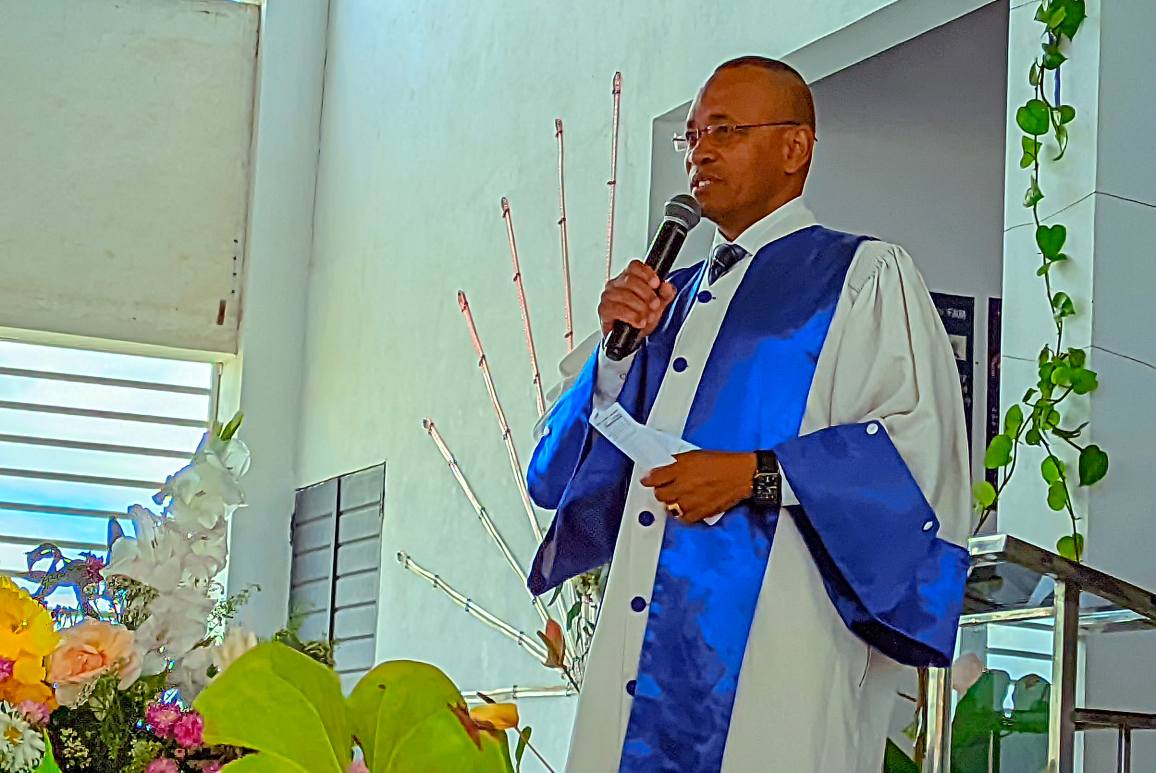


On February 8, 2025, at the FAM Church in Antsahatsiresy, Pastor Mailhol delivered a sermon on a central theme: marriage and family. He explored a biblical passage from the Song of Songs, emphasizing the challenge of interpreting its poetic and metaphorical language. One example is found in Song of Songs 4:5:
“Your breasts are like two twin fawns of a gazelle that graze among the lilies.”
This book, often seen as bold in its expressions, invites reflection: Why do such words appear in the Bible?
A Spiritual Covenant
Pastor Mailhol provided insight by referencing Jeremiah 3:1-25, where God calls Israel to return to Him despite its transgressions. He drew a parallel between God's relationship with Israel and the covenant of marriage: just as a husband remains faithful to his wife, God remains faithful to His people, offering forgiveness and mercy despite their unfaithfulness.
The Model of Christ and the Church
He also highlighted Ephesians 5:28-32, which teaches that a husband must love his wife as he loves himself, just as Christ loves the Church. This passage reveals that the perfect union between Christ and the Church serves as a model of unwavering love. Therefore, while the Song of Songs is often interpreted as an expression of human love, it ultimately symbolizes the sacred relationship between Christ and His Church.
True Beauty in God's Eyes
The sermon also referenced Proverbs 31:30:
“Charm is deceptive, and beauty is fleeting; but a woman who fears the Lord is to be praised.”
This verse reminds us that outer beauty is temporary, whereas the fear of the Lord and spiritual devotion are what bring true worth and recognition in God’s eyes.
A Message for the Church
In conclusion, the sermon emphasized that the Song of Songs illustrates the beauty and purity of the Church—the Bride of Christ, whom He desires to be without blemish. This is why this poetic book was included in the Holy Scriptures: it serves as a reminder of the intimate, profound, and pure relationship between Christ and His Church.

Wealth and Spirituality: Pastor Mailhol’s Biblical Reflection at FOIBE Ambohimarina (Sabbath, February 1, 2025)
-
Categories: Populaire
-
Mise à jour le: 16-Feb-2025








Pastor Mailhol addressed the theme of wealth in his sermon on Saturday, February 1, 2025, delivered at the Foibe Ambohimarina. He posed a fundamental question that has intrigued many believers: “Is it necessary to be rich? Who grants wealth?” According to him, there are only two sources of wealth: either the power of the devil or the power of God. He emphasized that wealth is a recurring topic in the Bible and that while some of the devil’s servants become rich through him, some of God’s servants are also blessed with wealth according to divine will.
The Biblical Perspective on Wealth
Among the examples of God's servants receiving wealth, Pastor Mailhol cited Abraham, King David, King Solomon, and other key figures from Israel's history. These men were not only spiritually blessed but also materially prosperous. However, at the same time, the Bible also recounts stories of wealthy individuals who served the devil, such as King Nebuchadnezzar. Although Nebuchadnezzar’s power and wealth were immense, he ultimately faced God’s judgment. Pastor Mailhol highlighted this paradox, revealing that there can be an interaction between divine blessing and worldly riches influenced by the devil.
The Bible further differentiates between kings established by God and those whose reign was driven by satanic influence. This raises a crucial point: not all wealth is a sign of divine favor. Some riches are bestowed by the enemy, and discerning the true source of one's wealth is essential for a believer. Pastor Mailhol challenged his audience with a thought-provoking question: “If you are rich, where does your wealth come from? From the devil or from God?”
How God Grants Wealth
To understand how God grants wealth, Pastor Mailhol referred to several biblical passages. In Matthew 6:19-21, it is written:
“Do not lay up for yourselves treasures on earth, where moth and rust destroy, and where thieves break in and steal; but lay up for yourselves treasures in heaven... for where your treasure is, there your heart will be also.”
This passage underlines that true riches are not merely material but are deeply connected to one’s relationship with God. Those who focus on heavenly treasures will receive God’s enduring blessings.
Another relevant passage is found in Ecclesiastes 5:18-19:
“This is what I have seen: it is good and pleasant to eat, to drink, and to rejoice in the well-being we have under the sun during the days given to us by God, for this is our portion. And also, everyone to whom God has given wealth and property, and to whom He gives the power to enjoy it, to take his share of it, and to rejoice in his work, this is a gift from God.”
Here, wealth is portrayed as a divine gift meant to be enjoyed responsibly. However, it is not an end in itself; rather, it is a tool for fulfilling God's purpose.
Does the Devil Also Give Wealth?
An essential question raised by Pastor Mailhol was whether the devil also grants wealth. The answer is found in Matthew 4:8-10, where Satan attempts to tempt Jesus:
“Then the devil took Him to a very high mountain and showed Him all the kingdoms of the world and their glory. He said to Him, ‘All these things I will give You, if You will bow down and worship me.’ But Jesus replied, ‘Begone, Satan! For it is written, ‘You shall worship the Lord your God, and Him only shall you serve.’”
This passage illustrates that Satan can offer riches, but at a terrible cost—worship and allegiance to him. The world is filled with people who have attained wealth through questionable means, often at the expense of their souls. Conversely, those who submit to God also receive material blessings, but these blessings come with peace, purpose, and eternal significance.
Serving God vs. Serving the Devil
Pastor Mailhol then posed another crucial question: How can one serve God to receive true riches, and how does serving the devil lead to wealth?
Using the parable in Luke 12:16-21, he illustrated the fate of a rich man who accumulated great wealth but was ultimately called a fool by God:
“The land of a certain rich man produced an abundant harvest. He thought to himself, ‘What shall I do? I have no place to store my crops.’ Then he said, ‘This is what I will do: I will tear down my barns and build bigger ones, and there I will store all my grain and my goods. And I will say to myself, ‘You have plenty of good things laid up for many years. Take life easy; eat, drink, and be merry.’ But God said to him, ‘You fool! This very night your soul will be required of you. Then who will get what you have prepared for yourself?’”
The key lesson here is that accumulating wealth for selfish reasons, without acknowledging God, leads to spiritual emptiness. True wealth is not measured by the abundance of possessions but by one’s alignment with God’s will.
True Wealth Comes from God
In conclusion, Pastor Mailhol emphasized that there are two sources of wealth: one from God and one from the devil. However, true wealth comes from God and is accompanied by peace, joy, and divine purpose. On the other hand, wealth acquired through pride, corruption, and greed is temporary and devoid of eternal value.
“Seek first the Kingdom of God and His righteousness, and all these things will be added to you” (Matthew 6:33).
Pastor Mailhol encouraged believers to trust in God’s provision, live righteously, and seek blessings that align with His will. Wealth in itself is neither good nor evil—it is the source and purpose behind it that determine whether it leads to eternal reward or destruction.

Pastor Mailhol's Sermon at FAM Ambohipo: Christian Joy and Its Consequences, January 11, 2025
-
Categories: Populaire
-
Mise à jour le: 27-Jan-2025








During his Saturday sermon, Pastor Mailhol meditated on a passage from the book of Philippians 4:4, which encourages us to "Rejoice in the Lord always." He emphasized that Christian joy is a choice, a state of mind that should accompany us at all times.
Christian Joy: A Daily Choice
Pastor Mailhol explained that Christian joy is a conscious decision that every believer must make, regardless of circumstances.
Biblical Examples of the Consequences of Human Choices
Moses and the Midianite Woman
Pastor Mailhol first mentioned Moses, who married a woman from the Midianite nation, a decision contrary to God's laws. Moses should not have married a foreign woman, which led to reproaches from Miriam and Aaron (Numbers 12:1). They criticized Moses, but God heard their complaints and rebuked them for meddling in matters that did not concern them.
David and Bathsheba
The story of David and Bathsheba was then discussed. Driven by desire, David committed a grave sin by taking Uriah's wife as his own. This led to dramatic consequences, including the death of the child he had with Bathsheba as God's punishment. However, David had another son, Solomon, who became king. Although David had several wives, it was the child he had with Bathsheba who inherited the throne.
Solomon and Idolatry
Pastor Mailhol highlighted that, even though David was responsible for his sin, it was the people who suffered from the plague sent by God, raising questions about divine justice. God inflicts suffering on the rebellious people because of the leaders' faults. The story of Solomon, David's son, was also recalled. Although he asked God for wisdom, he sinned by falling into idolatry after marrying foreign women, which led to the division of the kingdom. God told him that his kingdom would be taken during his son's reign, showing that the parents' sins often affect the following generations.
Criticizing God's Anointed
Those who criticize the actions of God's "anointed," like Moses and David, often suffer the consequences of their contempt. Pastor Mailhol mentioned leprosy, or "habokana" in Malagasy, as a disease that affects those who rise against divine authority, citing Numbers 12:9-10, where Miriam was struck with leprosy after criticizing Moses.
Spiritual Leprosy and Its Healing
Leprosy symbolizes the consequences of faults, whether physical or spiritual. It is a warning that criticism against God's authority does not go unpunished. Finally, Pastor Mailhol shared a solution to spiritual leprosy, drawn from the example of the ten lepers healed by Jesus. When ten men with leprosy met Jesus, they pleaded, "Lord, if you are willing, you can make us clean." Jesus told them to go show themselves to the priests, and they were all healed on the way. However, only one of them, a Samaritan, returned to give glory to God and thank Jesus for his healing (Luke 17:11-19).
This passage teaches us that, like the lepers, humans often remember God only in their moments of suffering. Once healed, they forget to return to Him to give thanks.